
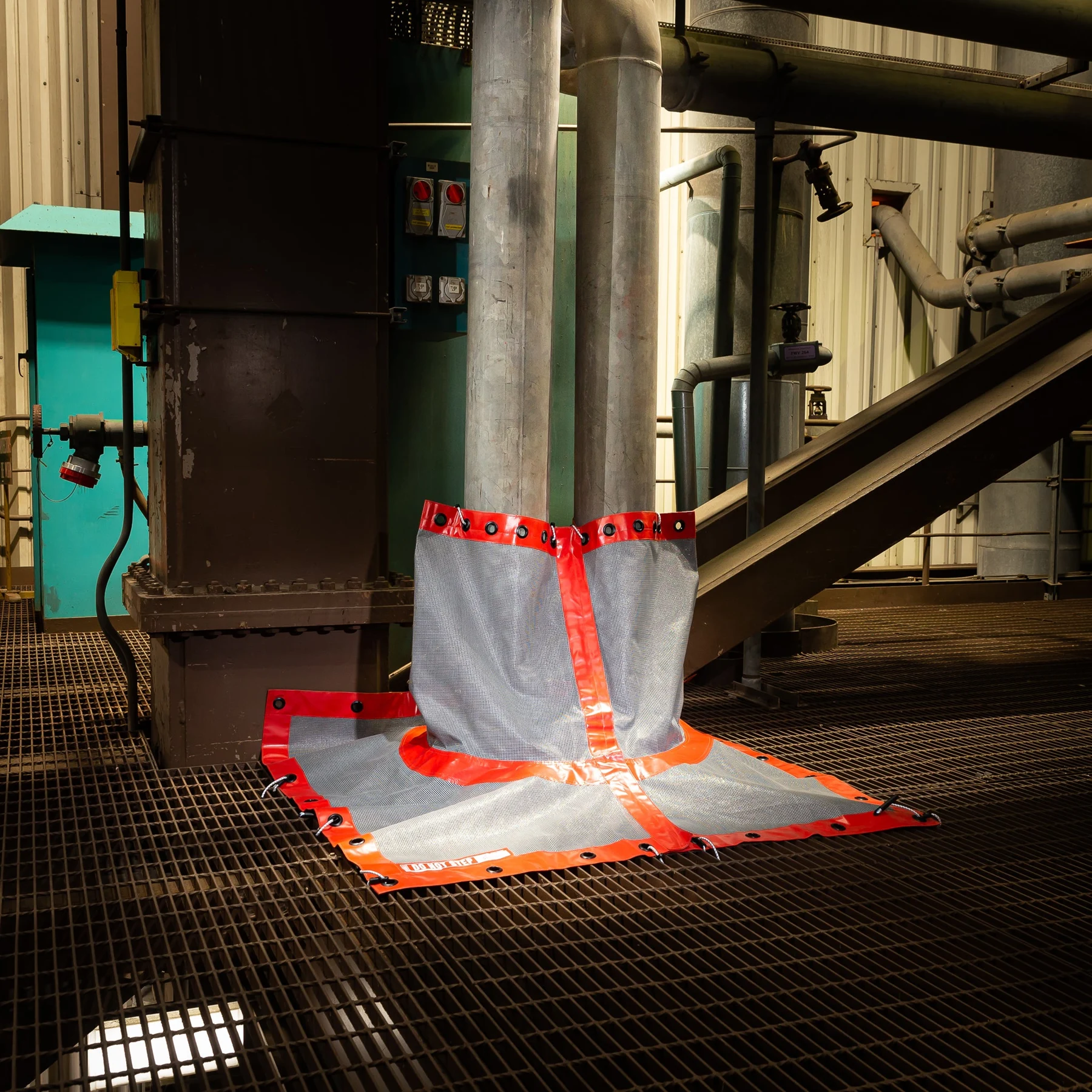
Identify the specific route
A pipe penetration differs from a grating aperture, and both differ from a platform edge. Draw or photograph the area with dimensions. Include the smallest component likely to be present, the surrounding support and any access requirement.
Select by coverage and retention
For a wrap-around pipe cover, check pipe diameter, collar closure, mat footprint and perimeter anchoring. For matting, check aperture, edge transitions and attachment. For a barrier, review rails, corners, gates and the base gap. An uncovered edge can remain a route for small parts.
Do not infer a walking surface
A flexible dropped-object cover may be designed only to stop small items passing through. It must not be treated as a platform, personnel fall-protection system or load-bearing floor without explicit documented approval for that use. Preserve clear identification of covered openings.
Treat moving equipment separately
A cover near a tubular, rotating equipment or changing opening needs a task-specific review. Confirm the approved operating state, installation and removal sequence and the risk of entanglement or interference. The rig or facility procedure controls whether the proposed arrangement is permitted.
Inspect after installation and changes
Check that closures are complete, attachments are fitted and edges remain controlled. Reassess after nearby work, equipment movement or a change in the gap geometry. Maintain access, drainage and other required functions of the area.
Turn the review into a product enquiry
Send PSC the task photographs, tool inventory and weights, fixture details or opening dimensions. Include the operating environment, required quantity and delivery location so the appropriate product configuration can be reviewed.